
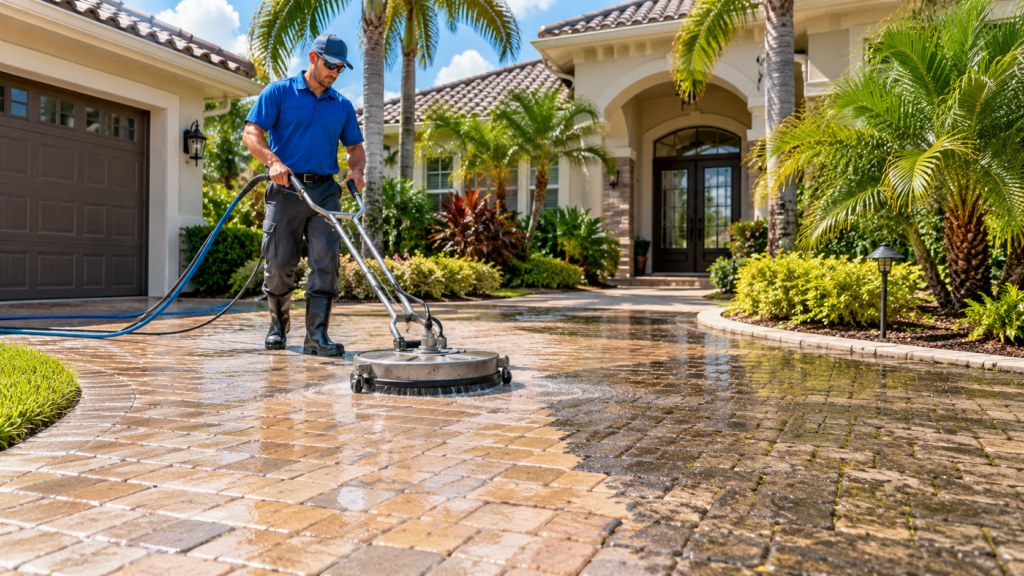
Do pavers need to be sealed after pressure washing? Not required, but in Florida it’s worth it. Pressure washing removes dirt, stains, and algae. Sealing keeps new stains from soaking in, binds the joint sand against weeds and washout, and helps the pavers hold their color. Gorilla Kleen seals with Seal-n-Lock, a water-based sealer that also stabilizes joint sand. Paver makers recommend resealing every 3 to 5 years.
What’s Involved in Professional Driveway and Paver Cleaning?
Gorilla Kleen cleans driveways and pavers in a set order: treat stains first, wash the whole surface with a wide spray, then re-sand the joints and seal if the surface is pavers. That order follows the Interlocking Concrete Pavement Institute’s cleaning guide.1
The order matters because each step sets up the next one. A sealer applied over a leftover oil spot locks the stain in, and sealer over dry, half-empty joints can’t hold the sand in place.
- Walk the surface and pretreat stainsOil, rust, and tire marks each need their own cleaner, applied before the main wash so the stain has time to lift.
- Protect plants and shut off sprinklersNearby beds get wetted down or covered, and irrigation stays off through cleaning, sealing, and drying.
- Wash the whole surfacePavers get a wide spray at a low angle so joint sand stays put. Concrete can take more, and 200-degree hot water cuts through oil and grease.
- Remove white haze if it’s thereEfflorescence, the chalky white film on concrete pavers, comes off with a dedicated cleaner before any sealer goes on.
- Rinse and manage the runoffWash water heads toward storm drains on most driveways, so we collect, filter, and recycle it where needed.
- Re-sand the jointsFresh joint sand goes into every gap the wash opened up, then the surface dries.
- SealOne coat of Seal-n-Lock goes on, and the area stays clear of cars and furniture until the sealer cures.
Pressure Washing vs. Paver-Safe Cleaning: What’s the Difference?
A concrete driveway can take a harder wash, but pavers sit on a bed of sand, so cleaning them has to lift dirt without blasting sand out of the joints. That difference changes the nozzle, the angle, and what happens after the wash.
Layer thicknesses from ICPI Tech Spec 2.1 A narrow, high-pressure jet strips the joint sand first.
Concrete driveways
Poured concrete is one solid slab with no joints to protect, so it handles a stronger wash. Oil drips from cars, rust from sprinklers, and tire marks are the usual problems, and each needs pretreatment before the wash. Hot water does most of the work on oil and grease. Property managers dealing with the same stains across a lot can see our commercial concrete and parking lot cleaning.
Paver driveways, walkways, and pool decks
ICPI’s guide puts professional paver cleaning at 600 to 2,000 psi, with a wide spray at a low angle so the water lifts dirt without digging into the joints.1 Get closer or narrower than that and the first thing to go is the sand between the pavers. That sand is what keeps each paver from rocking loose, so every paver wash ends with re-sanding. Pool decks get the same treatment, and if there’s a screen enclosure above, it makes sense to clean both on one visit. See our guide to cleaning the pool cage above a paver deck.
Efflorescence: the white haze on pavers
If your pavers look chalky or white after rain, you’re likely seeing efflorescence. ICPI describes it as a calcium carbonate deposit that rises out of the concrete as it gets wet and dries, and notes that it doesn’t affect the pavers’ strength.1 It does need to come off before sealing. Sealer applied over efflorescence locks the haze in.
| Factor | Concrete driveway | Paver driveway or walkway |
|---|---|---|
| Wash pressure | Higher pressure is fine on sound concrete | 600 to 2,000 psi, wide spray, low angle (ICPI) |
| Joints | Control joints only; nothing to wash out | Sand-filled; must be protected and re-sanded |
| Common stains | Oil, rust, tire marks, mildew | Same, plus efflorescence and weeds in joints |
| After the wash | Optional sealer | Re-sand joints, then seal |
| National cost, 600 sq ft (Fixr) | $180 to $200 | $195 to $225, before sealing |
Do Pavers Need to Be Sealed After Pressure Washing?
Pavers don’t have to be sealed, but Gorilla Kleen recommends it for Sarasota and Manatee County homes because sealing is what keeps a fresh wash from wearing off in one rainy season. Gorilla Kleen seals with Seal-n-Lock products.
ICPI calls a freshly cleaned pavement the right moment to stabilize the joints or seal.1 The surface is as clean as it will ever be, and the joints have just been refilled.
What sealing does
Joint sand, weeds, and ants
Paver manufacturer Nicolock recommends polymeric sand in the joints before sealing. It’s a fine sand with a binder that hardens when it gets wet.3 Seal-n-Lock’s own sealers are built to stabilize joint sand as they seal.4 Between the two, the joints stay full, which keeps the pavers tight and leaves weeds and ants less room to move in.
Florida sun, rain, and salt air
Sarasota-Bradenton averages 49.05 inches of rain a year, and about 29.5 inches of it falls from June through September.5 Every one of those storms works at open joints and soaks into unsealed pavers. Add year-round sun and, for homes on Longboat Key or along the bay, salt air, and unsealed pavers have a lot working against them.
Water-based vs. solvent-based sealers
Paver sealers come in two broad types. Solvent-based sealers need fully dry pavers. Seal-n-Lock’s sealers are water-based, low-VOC formulas that penetrate the paver and stabilize the joints.4 More sealer isn’t better: Nicolock warns that heavy coats trap moisture and can peel or turn cloudy white, which is why one even coat is the standard.3
Thinking about sealing? See our paver cleaning and sealing in Sarasota service for what’s included and how we prep the surface.
How Much Does Driveway and Paver Cleaning Cost?
Nationally, pressure washing a driveway averages about $225 for 600 square feet, or $0.30 to $0.40 per square foot, according to Fixr.2 Paver driveways run $195 to $225 for the same size before sealing, a little more than concrete at $180 to $200.
Dots mark the middle of each range. Source: Fixr, updated January 2025.2
| Factor | Effect on price |
|---|---|
| Square footage | The biggest driver; most companies price by the square foot |
| Surface type | Pavers cost a little more than concrete because of joint care and re-sanding |
| Stains | Oil, rust, and efflorescence each need pretreatment |
| Sealing | Priced separately; includes joint sand and one coat of sealer |
| Small jobs | A 10×10 patio is about $30 to $40 of work at national rates, but minimum charges near $100 are common |
Bundling usually lowers the per-surface cost, so a driveway, walkway, and pool deck in one visit costs less than three separate trips. For more on how exterior jobs are priced, see what drives exterior cleaning prices.
How Often Should Driveways and Walkways Be Cleaned?
Most Sarasota driveways and walkways need cleaning about once a year, and sealed pavers need a fresh coat of sealer every 3 to 5 years, the interval paver manufacturer Nicolock recommends.3 Driveways with daily car traffic and pool decks in full sun tend to wear sealer at the faster end of that range.
The water test for resealing
Sprinkle a little water on a few pavers. If it beads up, the sealer is still working. If it soaks in and darkens the paver within a minute, the sealer has worn through and it’s time to reseal.
New pavers
Nicolock advises waiting 6 to 12 months after installation before the first seal.3 ICPI notes that efflorescence on new pavers can peak within about 60 days, so the wait lets it surface and get cleaned off before sealer goes on.1
Frequently Asked Questions
Do pavers need to be sealed after pressure washing?
They don’t have to be, but sealing is what keeps the clean look. A fresh wash leaves pavers open to new stains and pulls sand from the joints. Sealing protects the surface, binds the joint sand against weeds and washout, and helps hold color. Gorilla Kleen seals with Seal-n-Lock.
How much does it cost to pressure wash a 10×10 deck or patio?
A 100 sq ft patio is about $30 to $40 of work at the national rate of $0.30 to $0.40 per square foot, but most companies set a minimum charge, often around $100. Adding the patio to a driveway or house wash is usually the better value.
How often should paver sealant be reapplied in Florida?
Paver manufacturers such as Nicolock recommend every 3 to 5 years. Driveways with daily car traffic and pool decks in full sun wear sealer faster. If water soaks in and darkens the paver instead of beading up, the sealer is worn and it’s time to reseal.
Can pressure washing damage pavers or grout lines?
Yes, when the tip is too narrow or too close. A concentrated jet blasts sand out of the joints and can etch the surface. ICPI guidance calls for a wide spray at a low angle, and joints should be re-sanded after cleaning before any sealer goes on.
What’s the difference between cleaning a concrete driveway and a paver driveway?
Concrete is one solid slab, so it can take a harder wash and hot water for oil stains. Pavers sit on sand, so the job adds joint care: a gentler spray angle, re-sanding, and usually sealing. A paver driveway takes longer and costs a little more as a result.
Why are my pavers turning white after cleaning?
That white haze is usually efflorescence, a harmless calcium deposit that rises out of concrete as it gets wet and dries. It doesn’t weaken the pavers. It should be removed with an efflorescence cleaner before sealing, or the sealer will lock it in.
Faded pavers, weeds in the joints, or oil spots on the drive? Gorilla Kleen cleans, re-sands, and seals driveways, walkways, and pool decks across Sarasota and Manatee County.
See Paver Cleaning & SealingOr get a free quote for any exterior surface.
Sources
- Interlocking Concrete Pavement Institute, ICPI Tech Specs 1–5, including Tech Spec 5, Cleaning, Sealing and Joint Sand Stabilization of Interlocking Concrete Pavement.
- Fixr, “Driveway Pressure Washing Cost,” updated January 31, 2025.
- Nicolock Paving Stones, “The Expert Guide to Sealing Pavers.”
- Seal ’n Lock Ultra Wet paver sealer, product description.
- NOAA National Centers for Environmental Information, U.S. Climate Normals 1991–2020, Sarasota-Bradenton.
studied Business Administration at Vanderbilt University and received his BA there.
- Pool Cage, Lanai & Screen Enclosure Cleaning: What Sarasota Homeowners Should Know - October 5, 2026
- Do Pavers Need Sealing After Pressure Washing? Sarasota Cleaning & Sealing Costs - October 2, 2026
- How long does it take to pressure wash a house? - September 18, 2026