
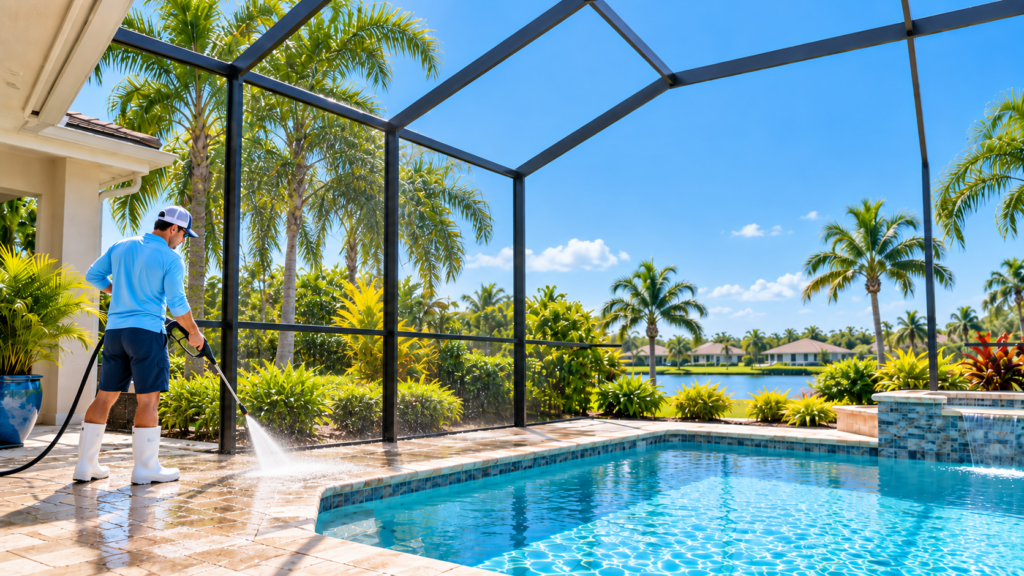
Can you pressure wash a pool cage? Not with standard high pressure. A pressure washer can tear the vinyl-coated fiberglass screen and mar the painted aluminum frame. Pool cages and lanais should be soft washed: a mild cleaning solution applied at low pressure, gentle brushing where needed, and a thorough rinse. In Sarasota’s humidity and salt air, most enclosures need this once or twice a year.
Can You Pressure Wash a Pool Cage or Screen Enclosure?
You can only if the pressure washer is turned down to low pressure, fitted with a wide fan tip, and held well back from the screen. Standard high-pressure washing damages both the screen mesh and the frame’s painted finish.
Most homeowners’ pressure washers are set up for concrete. Pointed at a screen panel, the same narrow jet that strips a stained driveway can punch through the mesh in a second. A torn panel means a rescreening bill on top of the cleaning, and a small tear doesn’t stay small once afternoon storms start working at it.
On a screen enclosure, the cleaning solution should do the work. The water only rinses. That’s the core difference between pressure washing and soft washing, and it’s why pool cages sit on the same list as roofs and stucco in our guide to surfaces you shouldn’t pressure wash yourself.
Why Does High Pressure Damage Screens and Frames?
Pool cage screen is thin vinyl-coated fiberglass and the frame is painted aluminum, so a concentrated jet can tear the mesh and scour the paint. Each part of the enclosure fails in a different way.
The screen mesh
Most Florida pool enclosures use pool-and-patio grade screen, such as Phifer’s 18×14 vinyl-coated fiberglass, which is about 0.013 inch thick.1 That’s roughly the thickness of three sheets of copy paper. It’s stronger than window screen and rated for salt air, but it’s still woven glass yarn under a vinyl coating, and a high-pressure stream hits it at a single point.
The aluminum frame
The American Architectural Manufacturers Association (AAMA) publishes the industry’s cleaning guide for painted and anodized aluminum. It starts with a plain water rinse at moderate pressure, moves to a mild detergent applied with a soft brush or sponge only if dirt remains, and ends with a full rinse. It warns against aggressive acid or alkaline cleaners and abrasive scrubbing, which damage painted finishes.2 Painted-aluminum supplier Wrisco advises against high-pressure washing on the same grounds: it can mar the finish.3
AAMA also advises against cleaning aluminum while it’s hot from direct sun, because cleaning chemicals react faster and leave streaks. On a west-facing lanai at 3 p.m. in July, that rules out a lot of the day, so we schedule enclosure work around it.
The pool and deck below
Anything sprayed on the cage can end up in the pool. Cleaner Times, a trade magazine for the pressure-washing industry, notes that cleaning solution seeping into pool water throws off its pH and has to be corrected afterward.4 A careful crew aims spray away from the water, rinses thoroughly, and checks the pool when the job is done.
| Factor | Standard pressure washing | Soft washing |
|---|---|---|
| What does the cleaning | Force of a narrow water jet | Cleaning solution, followed by a low-pressure rinse |
| Screen mesh | Can tear, puncture, or loosen panels | Low risk at rinse-level pressure |
| Painted frame | Can mar or lift weathered paint | Mild detergent and soft brush, per AAMA guidance |
| Mold, mildew, algae | Strips what’s visible on the surface | Solution treats growth so it lifts off and rinses away |
| Pool water | Overspray carries debris and grime into the pool | Controlled application, rinse, and water check |
How Do Professionals Clean a Screen Enclosure?
Professionals soft wash a screen enclosure: they apply a cleaning solution at low pressure, give it time to work, brush stubborn spots by hand, and rinse the screens, frame, and deck at low pressure. Here is how Gorilla Kleen runs a pool cage job.
- Walk the enclosure firstWe note torn panels, loose screen, and faded or chalky frame paint before any water goes on, so you know what was already there.
- Protect the pool and plantsFurniture comes off the deck, nearby plants get wetted down, and spray is directed away from the pool.
- Clear loose debrisCobwebs, leaves, and pollen come off with a blower or soft brush so the solution reaches the surface underneath.
- Apply the soft-wash solutionA mild cleaning solution goes on at low pressure across the screens and frame, working both sides of each panel.
- Let it work, then hand-brushAfter a short dwell time, stubborn spots on the frame and kick plates get a soft brush, never an abrasive pad.
- Rinse top to bottomRoof screens first, then walls, frame, and door, with the deck rinsed last so it carries everything off.
- Check the pool and the finishWe check the water and walk the enclosure again with you before we leave.
Gorilla Kleen is certified in the Soft Wash system, and screen cages are one of the surfaces it was built for. Where runoff is a concern, our equipment collects, filters, and recycles the wash water. If you manage several homes in a community, see our pool cage and lanai cleaning for Sarasota communities.
How Often Should a Pool Cage Be Cleaned in Florida?
Most Sarasota and Manatee County pool cages need cleaning once or twice a year. Enclosures in heavy shade, under trees, or close to the Gulf or the bay usually need it every six months.
Rain and humidity
NOAA’s 1991–2020 climate normals put Sarasota-Bradenton’s average rainfall at 49.05 inches a year, and about 29.5 inches of that falls from June through September.5 That’s 60% of the year’s rain in four months. A screen enclosure holds moisture in the mesh and along the frame long after the storm passes, and mildew and algae follow.
Source: NOAA 1991–2020 U.S. Climate Normals, Sarasota-Bradenton.
That’s why many homeowners book one cleaning in late fall, after the rainy season, and a second in spring before the pool gets heavy use.
Salt air on the coast
AAMA’s aluminum guide singles out coastal areas, where repeated cycles of condensation and drying leave a layer of salt and dirt that sticks hard to the frame. It also notes that sheltered spots get dirtier because rain never rinses them.2 On a lanai, those sheltered spots are the underside of the roof screens and the frame members along the house wall. Homes on Longboat Key, along the bay in Bradenton, and on the water in Venice see that buildup faster.
Shade, trees, and north-facing walls
Screens that never get direct sun stay damp longest, and oaks and pines drop pollen, sap, and needles that feed growth. The same conditions drive the black streaks on Sarasota roofs; we cover why mold and algae come back so fast in Sarasota in a separate guide.
| Your enclosure | Typical interval | Why |
|---|---|---|
| Open, sunny, inland (Lakewood Ranch, east Sarasota) | Once a year | Sun dries the screens quickly after rain |
| Shaded, north-facing, or under oaks and pines | Every 6 months | Screens stay damp, and pollen and sap feed growth |
| Waterfront or near the Gulf or bay | Every 6 months | Salt and condensation build up on the frame |
What’s Included in Lanai and Pool Deck Cleaning?
A full lanai service covers the screen panels, the aluminum frame, the screen door, the pool deck, and the furniture area, with the deck done last so the rinse water carries debris off.
The order matters: top to bottom, frame and screens before the deck.
| Area | How it’s cleaned | What it removes |
|---|---|---|
| Roof screens | Soft-wash solution, low-pressure rinse from the top | Pollen, leaves, needles, green film |
| Wall screens | Solution and rinse on both sides of each panel | Mildew, cobwebs, haze that blocks the view |
| Aluminum frame and door | Mild detergent, soft brush on stubborn spots | Salt film, dirt, spotting, insect nests |
| Kick plates | Hand-brushed and rinsed | Splash-back dirt and mildew along the bottom |
| Pool deck and furniture area | Cleaned last, matched to the surface (pavers, concrete, or coating) | Algae, slippery film, rinse-off from the cage |
Paver pool deck? A clean deck is the right moment to seal it. Sealing helps the pavers hold their color and keeps weeds and stains from setting back in. Gorilla Kleen seals with Seal-n-Lock products; see our pool deck paver sealing service.
Signs Your Screen Enclosure Needs Cleaning
Your enclosure is due if you see green or black film on the screens, a dull film on the frame, buildup in the corners, or a hazy view through the screen.
- Green or black film on the lower panels and the shaded side, where screens stay wet longest.
- A dull, spotty film on the frame that comes off on your finger. If it doesn’t wipe off, the paint itself may be aging.
- Cobwebs, pollen, and nests packed into corners and roof seams.
- A gray, hazy view through screens that used to look nearly invisible.
- A slick or stained deck along the base of the screen walls, where runoff from the cage lands.
- Yellow or brown streaks running down from the roof screens after rain.
How Much Does Pool Cage Cleaning Cost in Sarasota?
Pool cage cleaning is priced by the enclosure, and three things set the number: the size of the cage, how tall the screen walls are, and how much growth has built up since the last cleaning.
| Factor | Effect on price |
|---|---|
| Enclosure size | More square feet of screen and frame means more solution and more time |
| Wall and roof height | Two-story and high-peak cages need ladders or extension equipment |
| Buildup | A first-time or overdue cleaning takes longer than annual maintenance |
| Bundled services | Adding a house wash or pool deck in the same visit usually lowers the per-surface cost |
For a broader look at exterior pricing, see what drives exterior cleaning prices. For your enclosure specifically, a free on-site quote is the fastest way to a real number.
Frequently Asked Questions
Can you pressure wash pool screens without damaging them?
Only at low pressure. A pressure washer turned down, fitted with a wide fan tip, and held back from the screen can rinse it safely. Standard high pressure can tear the vinyl-coated fiberglass mesh and mar the frame’s paint. Professionals soft wash instead: a cleaning solution does the work, and the water only rinses.
How much does it cost to clean a screen enclosure in Sarasota?
Price depends on the enclosure’s square footage, how tall the screen walls are, and how much growth has built up. Bundling the pool deck or a house wash into the same visit usually lowers the per-surface cost. Gorilla Kleen gives free on-site quotes across Sarasota and Manatee County.
How often should a lanai be cleaned in Florida?
Once or twice a year for most Sarasota and Manatee County homes. Enclosures in heavy shade, under oaks or pines, or close to the Gulf or bay often need cleaning every six months because humidity, pollen, and salt air build up faster there.
Does cleaning a pool cage remove yellowing?
It removes yellowing caused by dirt, pollen, and organic growth, which is most of what homeowners see. Discoloration from sun-aged screen or chalky, faded paint on the frame won’t wash out. Those need rescreening or refinishing, and a good crew will tell you which you have before quoting.
Can screen enclosures be cleaned without removing the screens?
Yes. Professional crews clean the screens in place, working both sides of each panel, then rinse the frame and deck. Removing screens is only necessary for rescreening or repairs, not for routine cleaning.
Will pool cage cleaning chemicals get into my pool water?
A careful crew keeps them out. Runoff that reaches the pool can throw off its chemical balance, so professionals control spray direction, rinse thoroughly, and check the water afterward. Ask any company how they protect the pool before you book.
Green film on the screens or a hazy view from the lanai? Gorilla Kleen soft washes pool cages across Sarasota and Manatee County, with the pool protected from start to finish.
Request a Free QuoteSources
- Phifer Pool & Patio fiberglass screen specifications, via Ferguson product listing.
- American Architectural Manufacturers Association, AAMA 609 & 610-02, Cleaning and Maintenance Guide for Architecturally Finished Aluminum.
- Wrisco, “How to Clean and Maintain Painted Aluminum Sheet.”
- Cleaner Times, “Power Washer’s Guidebook: Cleaning Pool Decks and Patio Furniture,” June 2013.
- NOAA National Centers for Environmental Information, U.S. Climate Normals 1991–2020, Sarasota-Bradenton.
studied Business Administration at Vanderbilt University and received his BA there.
- Pool Cage, Lanai & Screen Enclosure Cleaning: What Sarasota Homeowners Should Know - October 5, 2026
- Do Pavers Need Sealing After Pressure Washing? Sarasota Cleaning & Sealing Costs - October 2, 2026
- How long does it take to pressure wash a house? - September 18, 2026