
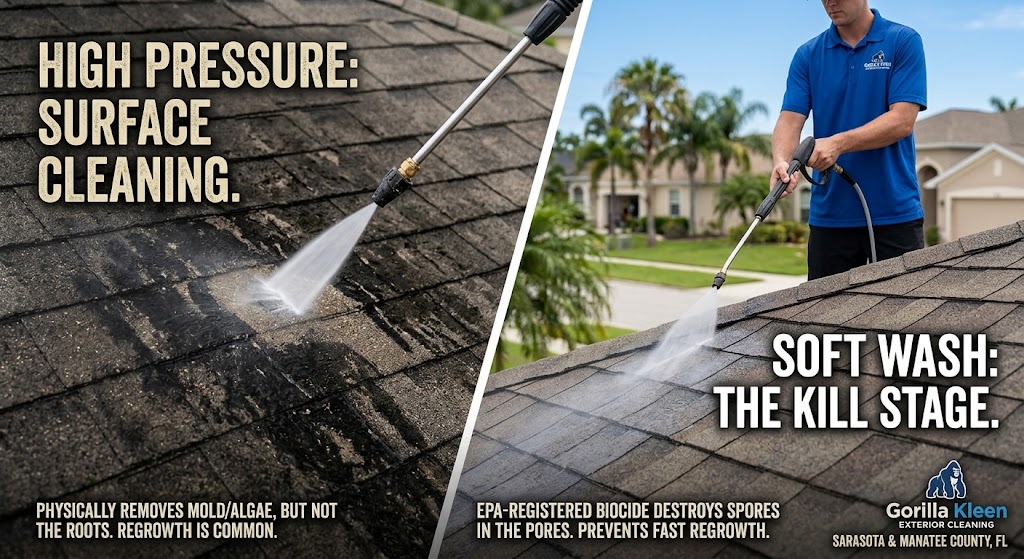
Pressure washing physically removes visible mold and algae from hard surfaces, but it doesn’t kill the roots — regrowth is common within weeks in Sarasota’s wet, humid climate. Soft washing with an EPA-registered biocide kills mold and algae at the source, which is why professionals use it on roofs, stucco, and shaded siding.
Does Pressure Washing Actually Remove Mold?
Yes, for what you can see. A pressure washer’s water force strips mold, algae, and mildew off siding, stucco, pavers, and roofing — the black streaks, green film, and gray haze disappear in a single pass. What it doesn’t do is kill what’s left behind in the pores of the surface.
Mold and algae spread by spores that lodge in tiny surface cracks and pits. Rinse the visible growth away and those spores stay put. Add Sarasota’s rainfall and they’re back within weeks. That’s the gap soft washing is built to close: a low-pressure application of an EPA-registered biocide that kills the organism at the surface, not just the parts you can see.
Why Mold and Algae Grow So Fast in Sarasota and Manatee County
Mold and algae need two things to spread: moisture and time between dry-outs. Sarasota supplies both. The area gets roughly 49 inches of rain a year, and more than half of it falls in a four-month stretch — June through September — based on 1991–2020 climate normals from the National Weather Service.
Humidity and Rainfall Patterns
Average monthly rainfall, Sarasota-Bradenton, in inches (1991–2020 normals). Highlighted bars mark the wet season, when regrowth after cleaning happens fastest. Source: NOAA / National Weather Service Tampa Bay Area.
That four-month wet stretch is exactly why a house cleaned in May can show new algae by August. It’s not a sign the first cleaning failed — it’s the climate resetting the clock.
Salt Air’s Role in Surface Porosity and Organic Growth
Homes near the Gulf pick up a second factor: salt air. Salt crystals are microscopically abrasive and slightly hygroscopic, meaning they pull moisture out of the air and hold it against the surface longer than dry air alone would. On stucco and concrete, that constant low-level moisture opens tiny pores over time, giving algae spores more surface area to grab onto.
Shaded, North-Facing Exteriors and Lanais
Direct sun dries a surface fast enough to slow mold and algae growth. Shade doesn’t. North-facing walls, areas under overhangs, and the underside of a pool cage or lanai screen stay damp longest after rain, which is why those spots are almost always the first to show streaking — often months before the rest of the house.
Black Streaks on Your Roof? Here’s What’s Actually Growing There
Most black roof streaks in Florida aren’t dirt, soot, or mold — they’re Gloeocapsa magma, a wind-borne cyanobacteria commonly called blue-green algae. According to GAF, one of the largest roofing manufacturers in North America, the organism is more prevalent in warm, wet climates and travels easily on the wind, which is why an entire street can develop streaking around the same time.
The color is a giveaway about how it survives: Gloeocapsa magma is naturally blue-green, but it grows a dark, UV-protective coating over itself to block sunlight — that coating is the black streak you actually see. It feeds on the limestone filler in asphalt shingles, and it almost always shows up first on north-facing roof slopes and areas under tree cover, for the same shade-and-moisture reasons covered above.
High-pressure washing is the wrong tool here. It can strip granules and shorten the life of the shingles. A soft wash treatment built for roofs removes the algae without touching the granule layer.
Is Mold on Your House a Health Risk?
The mold and algae growing on your roof or siding is mainly a durability and curb-appeal problem, not a direct health hazard while it stays outside. It becomes a health question when spores get inside — through an open window, a poorly sealed vent, or a damp attic space.
The EPA’s guidance on mold and moisture is direct on this point: mold exposure can trigger allergic reactions and worsen asthma in sensitive individuals, and the fix starts with controlling moisture, not just the mold itself. The CDC adds that mold exposure can cause a stuffy nose, sore throat, coughing, wheezing, and skin irritation, with more serious reactions possible in people who already have asthma, a mold allergy, or a compromised immune system.
Sources: U.S. EPA, “A Brief Guide to Mold, Moisture, and Your Home” (epa.gov/mold); CDC, Mold at a Glance (cdc.gov/mold-health).
The practical takeaway: exterior mold and algae are worth removing before they spread toward vents, soffits, and window frames — not because the roof itself is making anyone sick, but because that’s the path spores take indoors.
Pressure Washing vs. Soft Washing for Mold Removal
These two methods solve different problems, and the pressure gap between them is bigger than most homeowners expect.
Nozzle pressure ranges for the two methods. Source: manufacturer and industry PSI documentation cited in Gorilla Kleen’s DIY safety guide.
| Factor | Standard Pressure Washing | Soft Washing |
|---|---|---|
| Typical PSI at nozzle | 1,500–4,000+ | Under 500 |
| Kills mold/algae at the root | No — rinses surface growth only | Yes — biocide treats the organism |
| Best used on | Concrete, pavers, driveways | Roofs, stucco, painted siding, screens |
| Risk to delicate surfaces | Higher — can strip granules, drive water behind siding | Low — low mechanical force |
| How long results last | Weeks, in Sarasota’s wet season | Months to over a year, depending on shade/exposure |
How to Prevent Mold and Algae From Coming Back
- Trim back tree cover. Less shade means faster drying after rain, which is the single biggest factor in how fast growth returns.
- Clean gutters on a schedule. Clogged gutters send water down the siding instead of away from it, keeping walls damp longer than they should be.
- Use a preventive treatment on shaded, north-facing areas. These spots grow back first — treating them on a shorter cycle than the rest of the house keeps the whole property looking clean longer.
- Choose biodegradable, surface-appropriate detergents. The right chemistry lifts organic growth without damaging paint, sealant, or landscaping. See our eco-friendly pressure washing techniques for what we use and why.
- Match the cleaning method to the surface. Roofs and screens get soft washed; driveways and pavers can handle standard pressure. Mixing the two up is how surfaces get damaged.
Gorilla Kleen’s own process runs on an EPA-compliant contain-and-recycle wastewater system, detailed on our Our Environment page, so treating mold and algae doesn’t mean pushing chemicals into the storm drain.
Frequently Asked Questions
Does pressure washing kill mold or just remove it?
Standard pressure washing rinses mold and algae off the surface but usually doesn’t kill the spores lodged in its pores, so growth can return within weeks in a climate like Sarasota’s. Soft washing applies an EPA-registered biocide that kills the organism at the surface, which slows regrowth significantly.
What is the black stuff on my roof in Florida?
In most cases, it’s Gloeocapsa magma, a wind-borne blue-green algae — not mold, soot, or dirt. The black color is a protective coating the algae grows to block UV light, not its natural color.
Is mold on the outside of my house dangerous?
Exterior mold and algae are mainly a durability and appearance issue. They become a health concern if spores find a way indoors through vents, windows, or damp attic spaces, where the CDC notes they can trigger allergy symptoms and worsen asthma in sensitive people.
How often does a Sarasota home need mold/algae treatment?
It depends on sun exposure. Homes with heavy shade or north-facing walls often need attention more frequently than homes with full sun, which dries surfaces faster after rain. See our seasonal pressure washing schedule for a cadence based on your property’s exposure.
Can I use bleach to remove mold from siding myself?
You can, but it comes with trade-offs: bleach can discolor landscaping and fixtures, doesn’t penetrate porous surfaces as well as a commercial-grade biocide, and still requires the correct pressure and nozzle to avoid the same siding and roofing damage covered in our DIY pressure washing risks guide. For roofs and painted siding, a professional soft wash is the lower-risk option.
Seeing black streaks, green film, or gray haze on your roof, siding, or lanai? Gorilla Kleen soft-washes Sarasota and Manatee County homes with EPA-compliant, biodegradable treatments built to kill mold and algae at the source.
Request a Free Quote
studied Business Administration at Vanderbilt University and received his BA there.
- How long does it take to pressure wash a house? - September 18, 2026
- Can Pressure Washing Remove Mold, Mildew, and Algae in Florida’s Humidity? - September 15, 2026
- What Factors Affect the Overall Pricing of Pressure Washing Services - August 10, 2026